Poke is the closest thing in 2026 to an AI agent that is simply a contact in your phone. You sign up with a phone number, then text it over iMessage, SMS or Telegram (and WhatsApp in some markets) to manage your calendar, email, reminders, fitness data and smart home. It starts free, it has the best channel coverage of any consumer agent, and it is now owned by Cognition.
This review is based on Poke's public materials and press coverage, chiefly TechCrunch. We have not tested Poke hands-on, and we have no affiliation with it.
What is Poke?
Poke is built by The Interaction Company of California, a team of about ten based in Palo Alto, co-founded by Marvin von Hagen and Felix Schlegel. It opened to the public in March 2026 and has relayed about 100 million messages, according to the company.
- Messages relayed (company figure)
- ~100M
- First AI agent approved on Apple Messages for Business
- Jun 4, 2026
- Total funding before acquisition (reported)
- ~$25M
- Cognition acquisition announced
- Jul 23, 2026
On June 4, 2026, Poke became the first, and at that point the only, AI agent approved on Apple Messages for Business. Apple charges a per-user fee for that access; von Hagen has said it is lower than Meta's WhatsApp fees, though the figure is not public.
Ownership
Poke raised a $15 million seed and a further $10 million at a $300 million post-money valuation from Spark Capital and General Catalyst, reports StartupIntros; exact round labels vary by outlet. TechCrunch notes that Scott Wu and Walden Yan of Cognition were angel investors. On July 23, 2026, Cognition announced it was acquiring Poke for what TechCrunch called "low nine figures". Poke had already integrated Devin and Cursor Cloud Agents, which helps explain the fit.
How does Poke work?
There is no app to install. Everything happens in a message thread.
- Sign upGo to poke.com and enter your phone number.
- Pick a channelText from iMessage, SMS or Telegram; WhatsApp where available.
- Connect accountsLink Gmail, Google Calendar, Outlook, Notion, fitness trackers or smart-home devices.
- Text tasks"Move my 3pm to tomorrow", "What did my Oura say about sleep?", "Turn off the lights."
- AutomateDescribe a recurring automation in plain text, or install a shared recipe.
Channels
| Channel | Supported (as of Nov 2026) |
|---|---|
| iMessage | Yes (via Linq and Apple Messages for Business) |
| SMS | Yes |
| Telegram | Yes |
| Select markets only | |
| RCS | Not documented |
| Own app | None needed |
WhatsApp is the weak spot. Meta's ban on third-party general-purpose assistants has limited Poke there; TechCrunch reported access returning in Brazil after antitrust probes, with EU access depending on Meta's fees. The rules are covered in WhatsApp's AI chatbot ban explained.
What can Poke do?
Reported uses include daily planning, calendar management, email alerts, medication reminders, news summaries, health and fitness tracking, photo editing and smart-home control.
Integrations
Poke connects to Gmail, Google Calendar, Outlook, Notion, Linear, Granola, Strava, Withings, Oura, Fitbit, Philips Hue and Sonos. It also leans unusually far into developer tools: GitHub, Vercel, Supabase, Sentry, PostHog, Webflow, Devin and Cursor Cloud Agents. A developer can ask, by text, why a deploy failed.
Recipes
Automations written in plain text can be shared as "recipes". Recipe creators earn between $0.10 and $1 per signup they bring in, which gives Poke a small creator economy that no big-lab agent has.
How much does Poke cost?
Poke's pricing used to be murky, but it now has a public price list. As of November 2026:
| Source | What it says |
|---|---|
| TechCrunch (Apr 2026) | Starts free, then usage-based; real-time inference drives cost. Beta users negotiated $10 to $30 a month. |
| poke.com/pricing (Nov 2026) | Free ($0, "Free Forever"), Pro $19/month, Ultra $199/month, billed monthly |
The early "negotiate your price with the bot" approach got attention, but Poke now publishes fixed tiers on its pricing page. Our AI texting agent pricing page tracks changes.
Is Poke safe and private?
Poke says its team cannot see the contents of connected-account tokens by default and that it runs penetration tests. TechCrunch noted it did not audit those claims, and we have not seen an independent security audit.
A few structural points matter:
- iMessage is relayed. Poke's iMessage presence runs through Linq and Apple Messages for Business, so the conversation is not end-to-end encrypted between you and Poke. SMS is never end-to-end encrypted. See AI texting agents and encryption.
- Anyone can text a number. An agent that reads incoming messages and email can be targeted by prompt injection via messages.
- Ownership changed. Policies set by a ten-person startup may change under Cognition. Check the current privacy policy before connecting health or financial accounts.
Pros and cons
Pros
- True SMS and iMessage support, no app needed
- Works on Telegram, and WhatsApp in some markets
- Free to start
- Broad integrations, including fitness, smart home and developer tools
- Shareable plain-text automations
Cons
- Top tier ($199 Ultra) is expensive
- WhatsApp limited to select markets
- No independent security audit
- Future direction depends on Cognition
Who it's for / who should skip it
Poke is for you if you want an agent in your existing message thread, especially on iPhone, you use Google or Outlook calendars, track health with Oura, Fitbit or Strava, or you are a developer who wants deploy and error alerts by text.
Skip it if you mainly use WhatsApp outside Poke's supported markets (look at Meta Muse on WhatsApp), you need audited security for sensitive work data, or you want a big-lab agent with its own cloud computer, in which case compare Poke vs OpenAI dots.
Bottom line
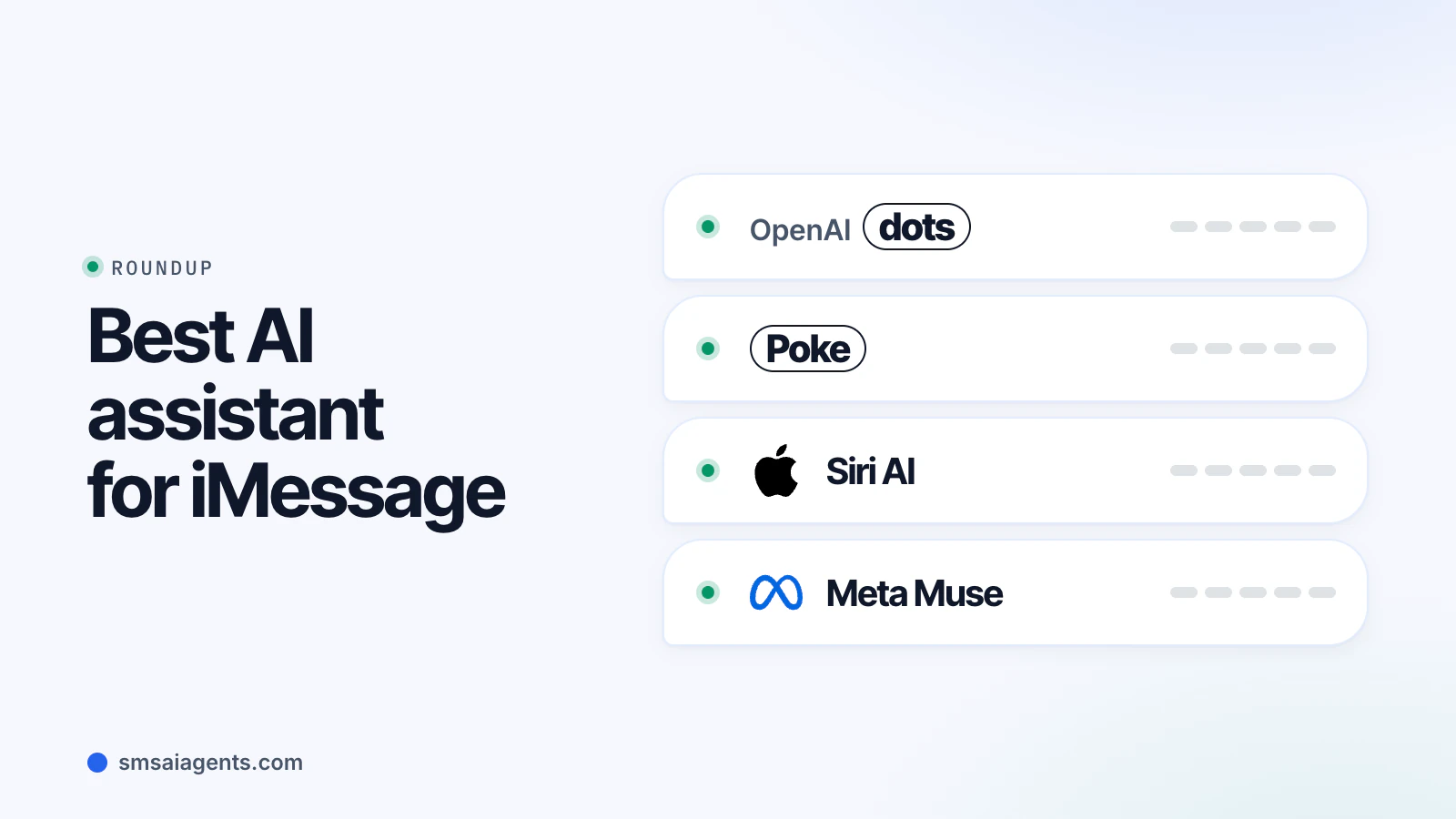
Poke is the best example of what a texting-first agent can be: no app, broad channels and a free way in. The open questions are price transparency, WhatsApp access and what Cognition does with it. For the wider field, see the best AI agents you can text and startup texting agents compared.