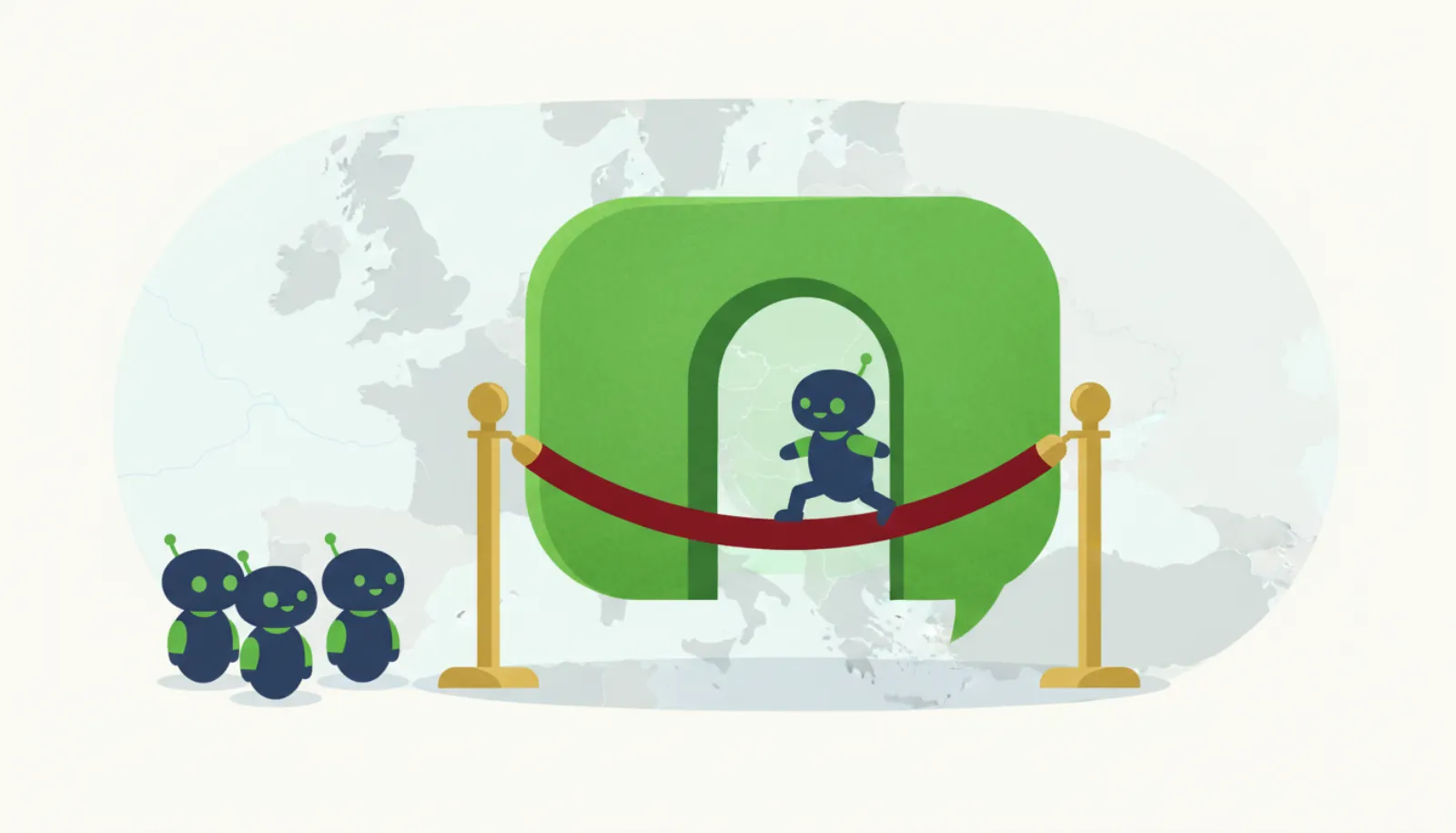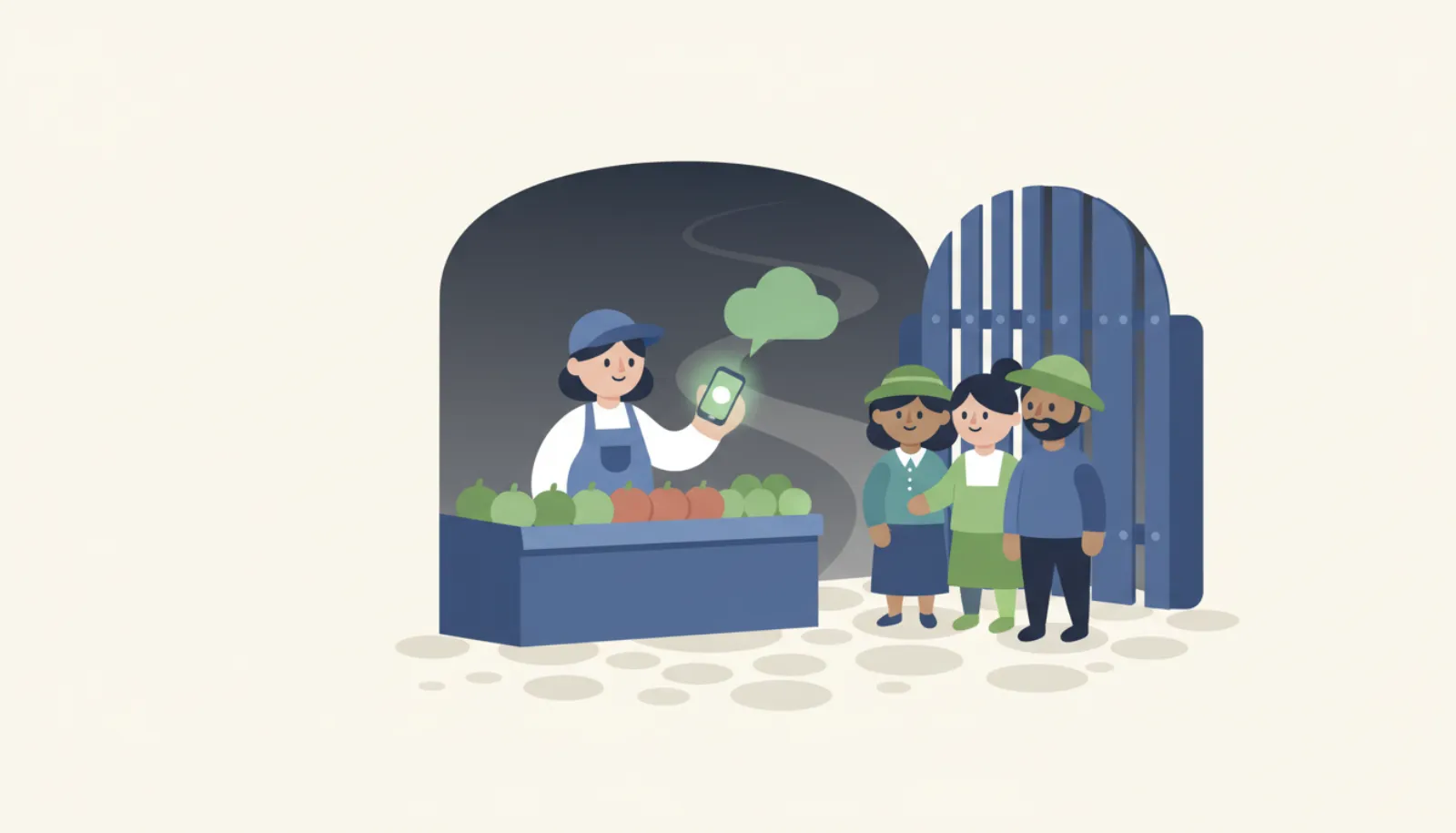
Businesses can still run AI agents on WhatsApp in 2026. Meta's policy change, in force for all API users since January 15, 2026, bans third-party general-purpose AI assistants whose main function is the chatbot itself. It does not ban a business using AI to answer its own customers, book appointments, take orders or send updates. That is why ChatGPT and Microsoft Copilot left WhatsApp while customer-service bots built on Fin, Zendesk, Salesforce or Twilio stayed.
Pricing is as of November 2026. This guide is based on Meta's developer documentation, vendor pages and news coverage. For the consumer side of the story, see the WhatsApp AI chatbot ban explained.
What did Meta change in 2026?
Meta added an "AI providers" section to its WhatsApp Business Solution terms. It bars providers whose primary offering on WhatsApp is a general-purpose AI assistant, while businesses that use AI for their own customer support are not affected (respond.io).
- AI providers terms apply to new WhatsApp Business API users
- Italy's AGCM orders Meta to suspend the ban in Italy
- Terms apply to all users; ChatGPT and Copilot leave WhatsApp
- Meta offers paid access to rival chatbots in the EU
- European Commission rejects the paid-access remedy
- Commission imposes interim measures restoring free access in the EU
OpenAI confirmed ChatGPT would stop working on WhatsApp after January 15, 2026 (OpenAI), and Microsoft did the same for Copilot (Microsoft). Meta AI, and later (according to most launch coverage) Meta's own personal agent Muse for US adults, became the only general-purpose assistants on WhatsApp outside the EU. See Meta Muse on WhatsApp.
Is my business AI agent allowed?
The test is whether the AI supports your business or is the product.
| Use | Allowed under the 2026 terms? |
|---|---|
| Airline answering booking questions with AI | Yes: own customer service |
| Clinic booking and reminders via an AI agent | Yes |
| Retailer AI handling order status and returns | Yes |
| Agency running AI support for each client's own customers | Generally yes, on each client's business account |
| A startup offering "chat with our general AI assistant on WhatsApp" | No, outside the EU |
| Reselling access to a general-purpose model via a WhatsApp number | No, outside the EU |
This table is our reading of the published terms and coverage, not legal advice. If your AI answers open-ended questions unrelated to your business, you are closer to the line; keep the agent scoped to your products and services.
Coverage of the EU order: WTOP/AP. For how UK users are affected compared with the EU, see UK vs EU AI features.
How much does a WhatsApp AI agent cost?
WhatsApp's pricing model is different from SMS (Meta pricing docs):
- Per-message pricing began
- Jul 1, 2025
- Free service messages per number (charged above that since Oct 1, 2026)
- 1,000/mo
- Utility templates inside the 24-hour window
- Free
- When Meta can change rates
- Quarterly
- Per-message billing since July 1, 2025 for template messages.
- Marketing, authentication and out-of-window utility templates are charged by the recipient's country code.
- Service messages, meaning replies within 24 hours of a customer's message, were free from November 1, 2024. Since October 1, 2026, Meta charges per message after 1,000 free delivered service messages per business phone number a month, with no rollover. Eligible government and non-profit organisations stay free through December 31, 2027.
- Utility templates inside the 24-hour window are free.
- Rate changes happen only on the first day of a quarter.
For an AI support agent that mainly replies to customers who message first, Meta's own charges stay low for small volumes, but busy numbers now pay for service messages beyond the free 1,000. Your costs are then the AI layer and the platform: Fin at $0.99 per outcome, Zendesk at $1.50 to $2.00 per automated resolution, or Agentforce with Salesforce Message Credits priced on a WhatsApp rate card dated November 2026 (Salesforce). Business solution providers (BSPs) such as Twilio, Sinch and Infobip may add their own per-message fees. See what an SMS AI agent costs.
Which tools can run a WhatsApp AI agent?
- Helpdesk AI agents: Fin (Intercom), Zendesk AI agents and Salesforce Agentforce all support WhatsApp alongside SMS. Compared in AI SMS customer support.
- Messaging platforms: Twilio (Agent Connect covers WhatsApp, SMS, RCS and voice), Sinch and Infobip. See SMS AI agent platforms compared.
- SMB suites: HighLevel's Conversation AI covers WhatsApp alongside SMS and social channels.
- Build directly: Meta's WhatsApp Cloud API with your own model. See building a WhatsApp AI agent on the Cloud API.
- Verify your businessSet up a WhatsApp Business account and verify it in Meta Business Manager.
- Choose a routeHelpdesk AI, messaging platform or direct Cloud API.
- Scope the agentLimit it to your products, services and policies.
- Approve templatesGet utility and marketing templates approved for business-initiated messages.
- Plan handoffRoute complaints, payments and sensitive topics to staff within the 24-hour window.
Should you use WhatsApp or SMS?
- US customers: SMS still reaches everyone without an app; WhatsApp is a useful second channel.
- Latin America, Europe, India and much of Africa and Asia: WhatsApp is often the default, and service messages (free up to 1,000 a month per number) often make it cheaper than SMS.
- Both: platforms such as Twilio and Fin let one agent run on both channels.
See AI agents by channel for a full comparison.
WhatsApp's advantages for a business AI agent are low-cost customer-initiated service conversations (1,000 free per number a month), rich messages (buttons, lists, images, documents) and explicit permission for business AI support under the 2026 terms. The drawbacks: general-purpose AI products are banned outside the EU, business-initiated messages need pre-approved templates, and EU rules are in flux while the Commission's case continues.
Bottom line
The 2026 WhatsApp policy change closed the door on third-party general-purpose chatbots, not on businesses using AI to serve their own customers. If your agent is scoped to your products and services, you can run it on WhatsApp through a helpdesk, a messaging platform or the Cloud API, and customer-initiated conversations cost nothing in Meta fees. Watch the EU case if you operate there, because the rules for general-purpose assistants differ by region.